For pool ladders and hardware, 304 vs 316 stainless steel comes down to salt. 316 has added molybdenum, about 2 to 3 percent, which helps it resist pitting from chlorides. That makes 316 the usual choice for salt chlorine pools and homes near the coast. 304 works well in a standard chlorine pool as long as you rinse it with fresh water and clean it on a routine.
Below we cover what the two grades share, where they differ, which one fits your pool and how to deal with rust spots and staining.
What 304 and 316 have in common
Both are austenitic stainless steels, the family commonly used for pool rails, ladders, escutcheons and bolts. Both get their corrosion resistance from chromium, which forms a thin, invisible oxide layer on the surface. As long as that layer is intact, the steel underneath is protected. When it gets scratched, it rebuilds itself in contact with air.
304 is often called 18/8 steel because it has roughly 18 percent chromium and 8 percent nickel. 316 has a similar base with molybdenum added. On the deck, 304 vs 316 stainless steel looks the same. You cannot tell the grades apart by eye, so go by the grade the listing states.
Stainless does not mean the steel can never stain. It means it stains less. Both grades need some care around pool water.
304 vs 316 stainless steel: the molybdenum difference
Chlorides are the problem. Salt is sodium chloride, and chloride ions can break through the oxide layer in tiny spots. Once a spot opens, corrosion digs in and forms a small pit. That is pitting, and it is a common way stainless breaks down around pools.
Molybdenum makes the oxide layer harder for chlorides to break. That is why 316 is the grade people reach for around salt water. A salt chlorine pool carries much more dissolved salt than a standard chlorine pool, and coastal air carries salt spray that dries on every surface it touches. In both cases, a 316 stainless steel pool ladder or 316 hardware gives you more margin.
In a standard chlorine pool with balanced water, 304 holds up well. Many stainless pool ladders are made from it, and with a regular rinse it keeps its finish for years.
304 vs 316 stainless steel: which grade fits your pool
| Your pool | Grade to choose | Why |
|---|---|---|
| Standard chlorine pool, inland | 304 | Holds up well with balanced water and a routine fresh water rinse. |
| Salt chlorine generator | 316 | Molybdenum improves resistance to chloride pitting. |
| Near the coast, any sanitizer | 316 | Salt spray settles on the ladder even if the pool water is not salty. |
| Parts in splash range all season | Match the ladder, or 316 in salt pools | Escutcheons, bolts and anchors stay wet and trap water in gaps. |
Stainless steel pool ladder options by grade
Here is what our listings state about the steel in some of our stainless ladders and parts. When a listing does not name a grade, ask us before you buy if grade matters for your pool.
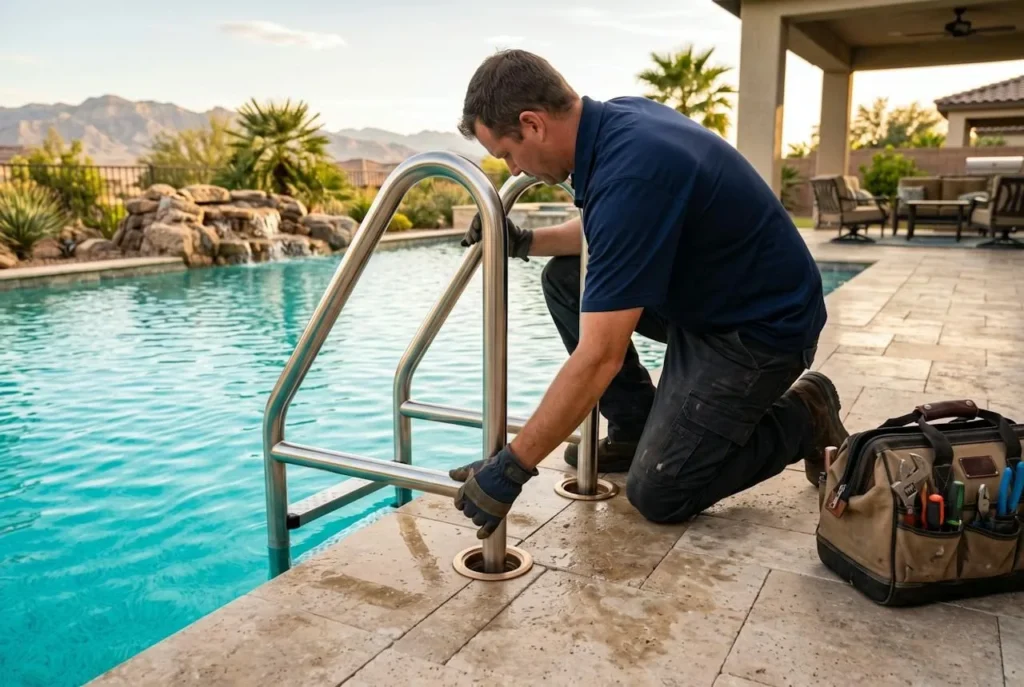
- The 3 step stainless ladder for inground pools is 304 stainless steel with two curved handrails and a 265 lb rating.
- The 304 stainless ladder with handrails comes with 2, 3, 4 or 5 steps.
- The heavy duty in ground pool ladder has a stainless frame and a 440 lb rating. Its listing does not name the grade.
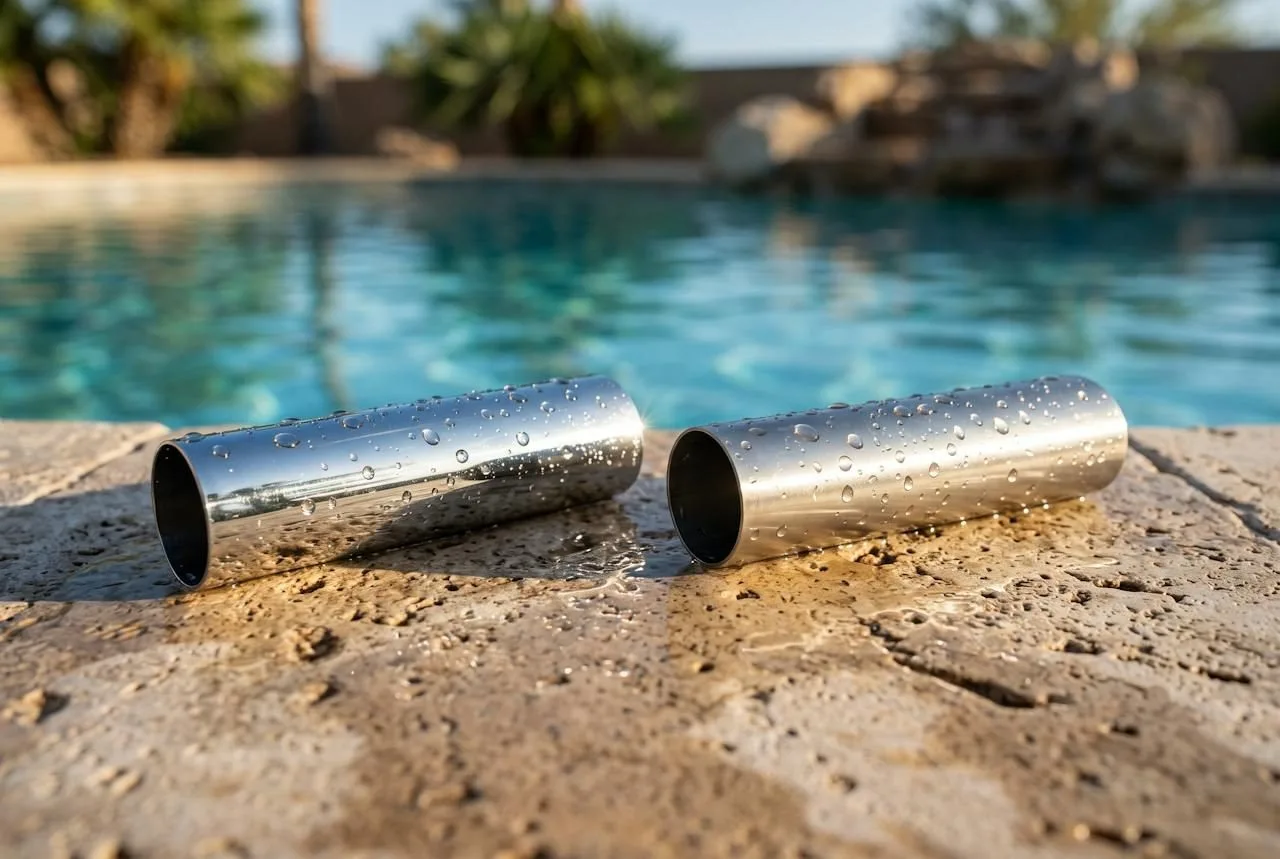
- The 316 stainless escutcheon 2 pack fits 1.9 in tubing and suits salt water pools.
- The polished 304 escutcheon 4 pack fits 1.9 in tube ladders and handrails.
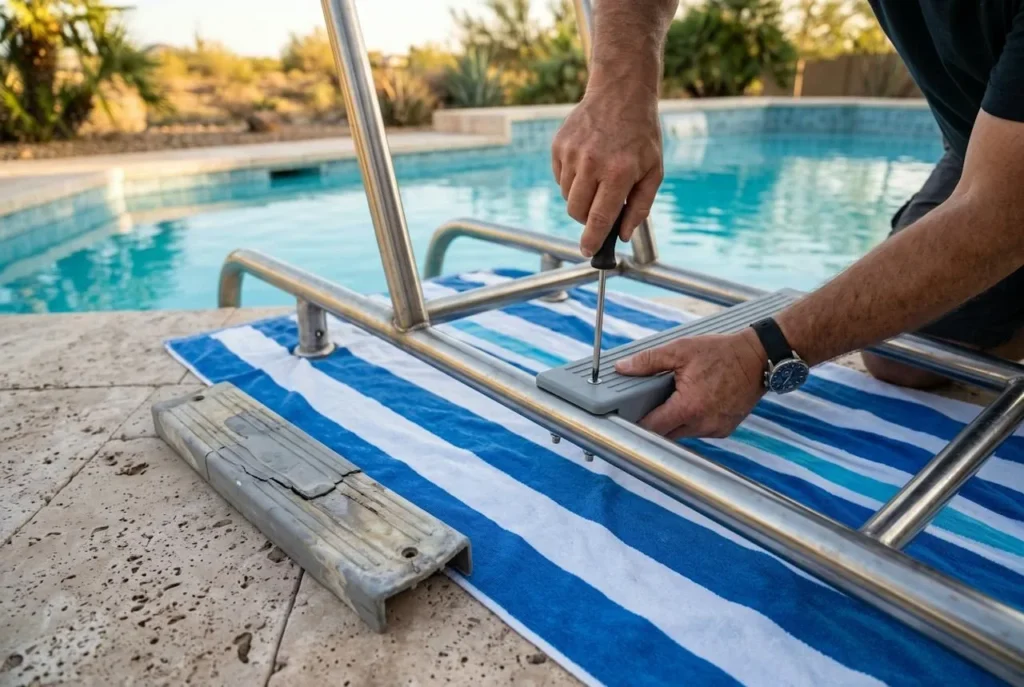
- The stainless replacement steps 6 pack are 304 stainless steel with a rubber tread, rated for 300 lb.
Browse complete ladders in inground pool ladders and hardware in pool ladder parts. Our pool ladder replacement parts guide helps you match parts to your tube size.
Why pool ladder rust shows up
Rust on a stainless ladder usually comes from one of these causes:
- Tea staining. A light brown film on the surface, common near the coast and around salt pools. It is mostly cosmetic and cleans off if you catch it early.
- Iron contamination. Steel wool, wire brushes, grinding dust or nearby steel tools leave iron particles on the surface. Those particles rust and look like the ladder is rusting.
- Salt left to dry. Splash water evaporates and leaves salt behind on the rails, especially on the top bends you grab most.
- Water chemistry. Water that stays out of balance is harder on all metal in the pool. Keep it balanced according to your test kit.
- Trapped water. Gaps under escutcheons and inside anchors stay wet and are where staining often starts.
- It is not stainless. Many A-frame ladders use coated carbon steel. If the coating chips, the steel underneath will rust.
How to clean stainless pool ladders and hardware
- Rinse the ladder with fresh water from a hose, top to bottom.
- Wash with mild soap or a mild stainless steel cleaner on a soft cloth or non-scratch pad. Wipe along the grain of the finish.
- For tea staining or small rust spots, use a cleaner made for stainless steel and follow its directions.
- Rinse again with fresh water so no cleaner stays on the metal, then wipe dry.
- Never use steel wool or a wire brush. They scratch the surface and leave iron behind, which starts new rust spots.
In a salt pool or near the coast, a quick fresh water rinse every week or two goes a long way. Pull the ladder for winter if your pool closes, and clean it before you store it.
Frequently Asked Questions
Is 304 or 316 better for pools?
For salt chlorine pools and coastal homes, 316 is the better choice because molybdenum improves its resistance to chloride pitting. For a standard chlorine pool with balanced water and routine rinsing, 304 works well.
How do I remove rust from a pool ladder?
Rinse with fresh water, clean the spots with a mild stainless steel cleaner and a soft cloth or non-scratch pad, then rinse and dry. Avoid steel wool, which leaves iron particles that rust.
Why is my pool ladder rusting?
Common causes are salt drying on the rails, iron particles from tools or steel wool, water that stays out of balance, water trapped under escutcheons, or a ladder that is coated carbon steel rather than stainless.